
At first glance, Oktoberfest appears to be the ultimate consumer spectacle—a sprawling canvas of brass bands, roasted meats, and millions of liters of amber lager poured beneath massive temporary tents. Yet, to view this annual gathering through the lens of modern mass tourism is to miss the profound civic ritual taking place beneath the rafters.
When you sit at a long wooden table inside a Munich beer hall, surrounded by locals in tailored Lederhosen and boiled-wool jackets, you are not merely attending a festival. You are participating in a two-hundred-year-old civic liturgy. Beneath the joyous surface of Oktoberfest lies an intricate history of medieval monastic engineering, strict agricultural policy, and an unyielding commitment to regional sovereignty.
To understand Bavaria, one must look past the steins and examine how a trade once managed by monks transformed into the defining pillar of a culture.
The Monastic Engineers of early Munich
The story of Munich’s beer culture does not begin with royal celebrations, but with silent contemplation and agricultural survival. The very name Munich derives from the Old High German Forum apud Monachos—”Market at the Monks.” Founded along the banks of the Isar River, the early settlement grew under the influence of Benedictine and Augustinian friars.
In the Middle Ages, brewing was an exact, highly regulated science practiced within monastery walls. Monks perfected fermentation not only to sustain themselves during the strict dietary fasts of Lent—coining heavy, nutrient-rich brews as “liquid bread”—but also as a matter of public health. River water along major European trade corridors was notoriously prone to contamination; the boiling and fermentation processes inherent to brewing rendered liquid safe for consumption.
As trade routes expanded, monastic orders engineered sophisticated hydraulic systems, malt houses, and underground cellars dug deep into the riverbanks. Brewing quickly shifted from a quiet spiritual necessity into a formidable economic engine. When civic trade guilds eventually wrested control of production from the monasteries, the technical rigor, recipe discipline, and communal responsibility established by those early friars remained permanently embedded in Munich’s DNA.
The Reinheitsgebot of 1516: Protectionist Policy as Cultural Pillar
In 1516, Duke Wilhelm IV of Bavaria issued a decree in the city of Ingolstadt that would forever alter the culinary history of Central Europe: the Reinheitsgebot, or Bavarian Beer Purity Law.
The law was stark in its simplicity. It declared that the only ingredients allowed in the brewing of beer were water, barley, and hops (yeast, being a microscopic organism, was not yet understood, though its effects were recognized).
While modern marketing often frames the Reinheitsgebot as the world’s oldest food-safety law, its origins were deeply political and economic:
This strict regulation forced Munich’s brewers to innovate within narrow boundaries. Excellence could not be faked with additives; it required mastering water chemistry, grain roasting, and precise cold-lagering techniques. The law elevated brewing from a basic trade to an art form, giving rise to Munich’s legendary “Big Six” breweries—including Augustiner, Paulaner, and Hacker-Pschorr—which still hold exclusive rights to serve at Oktoberfest today.
From Royal Wedding to Civic Cathedral
If monastic science provided the foundation and Duke Wilhelm IV provided the law, Crown Prince Ludwig provided the stage.
On October 12, 1810, Crown Prince Ludwig (later King Ludwig I) married Princess Therese of Saxe-Hildburghausen. The royal family invited the citizens of Munich to celebrate on the open meadow outside the city gates, a space named the Theresienwiese (“Therese’s Meadow”) in the bride’s honor. The festivities concluded with a grand horse race, an event so popular that the agricultural association decided to repeat it the following year, combining it with a state farming exhibition (Landwirtschaftsfest).
Over the next century, the horse races faded, but the agricultural showcase and civic gathering endured. The temporary beer booths expanded into massive timber halls—masterpieces of temporary vernacular architecture built to accommodate thousands of guests under single roofs decorated with hops and boxwood garlands.
Oktoberfest evolved into an annual assertion of Bavarian regional identity. Following the unification of Germany under Prussian leadership in 1871, Bavaria fought tenaciously to preserve its cultural distinctiveness within the new empire. Wearing traditional Tracht (Lederhosen and Dirndls), singing regional folk anthems, and drinking native lager were not mere nostalgia; they were subtle political declarations of Bavarian self-reliance and heritage.
The Democracy of the Long Table

To truly understand the social architecture of Munich’s beer culture, one must observe the seating arrangement inside a hall like Augustiner or Schottenhamel.
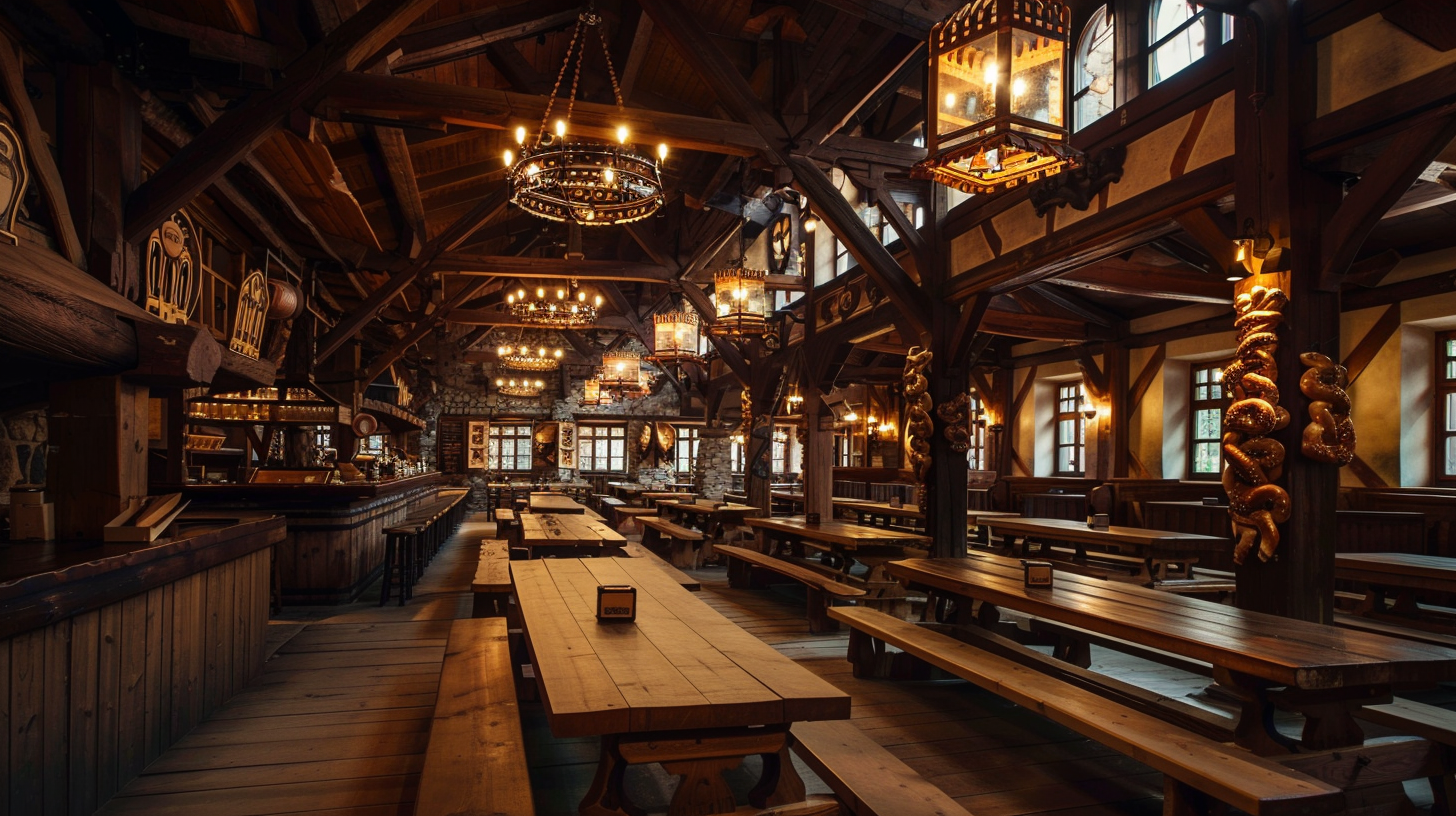
Unlike standard restaurants with small, isolated tables, Bavarian beer halls are designed around long, shared wooden benches. In a culture historically marked by formality and social structure, the long table acts as a democratic equalizer. Professors sit alongside carpenters, and third-generation Munich residents share bread with international travelers.
To sit at a shared table requires interaction. The customary eye contact made during a toast (Prost) is an unwritten contract of mutual respect. In an increasingly digital and fragmented world, these spaces preserve an ancient human need: the face-to-face gathering over shared food, regional drink, and spirited conversation.
The Opening Chapter of a Larger Story
Understanding Munich’s monastic roots, brewing purity laws, and public gatherings reveals that Oktoberfest is far more than a party. It is a masterclass in how a culture preserves its history through living traditions. The beer served in the giant halls on the Theresienwiese is a direct liquid connection to 16th-century ducal decrees, medieval monastic science, and 19th-century royal celebrations.
Yet, Munich and its beer halls represent only the first movement in a grander Central European composition.
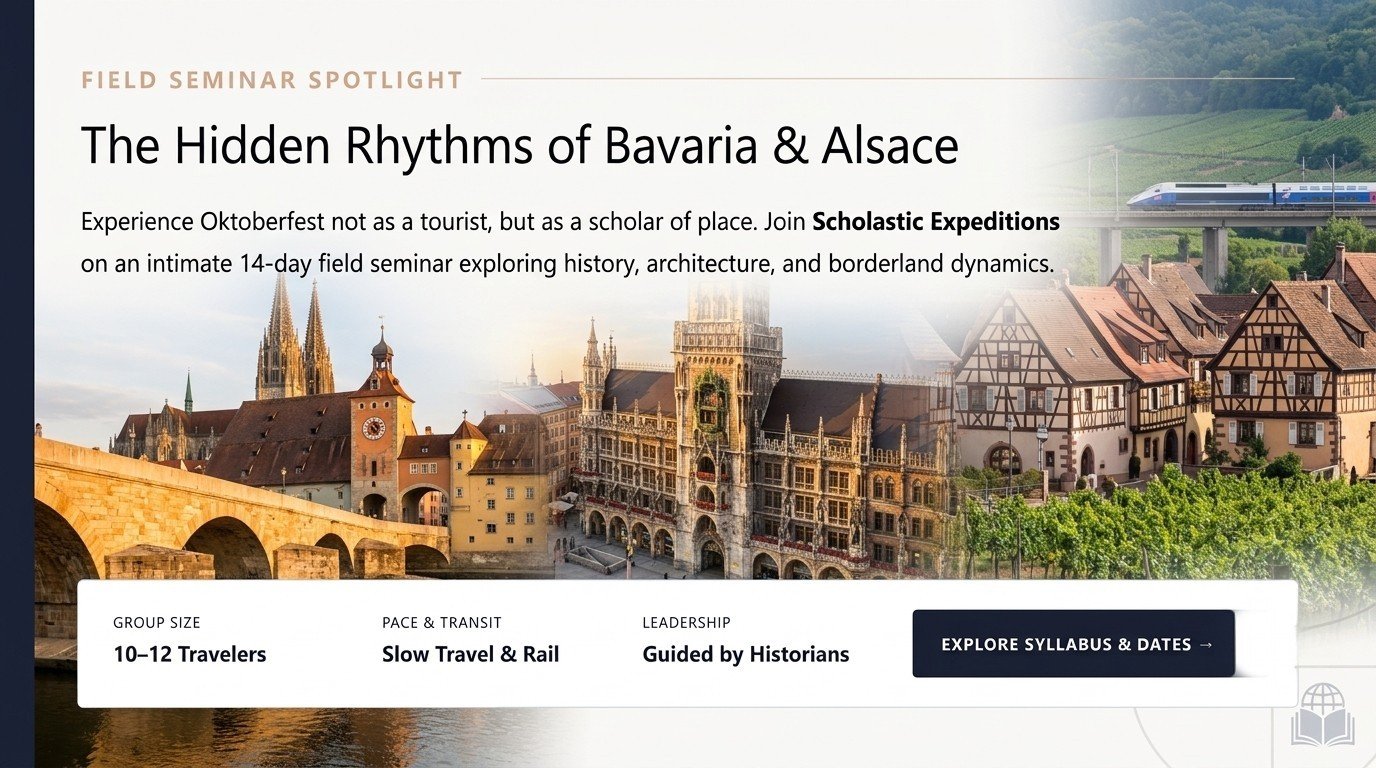
To truly grasp how history, trade, and geography shape the modern cultural landscape, one must follow the river currents and trade routes outward from Munich—traveling down the Danube corridor to the undamaged medieval stone streets of Regensburg, and ultimately crossing the Rhine into the contested, half-timbered borderlands of Alsace.
Field Seminar Learning Outcomes
Academic Takeaways for Stage 1: Munich & Ingolstadt
Through primary document analysis in Munich archives, field visits to historic monastic cellars, and site examinations along the Danube, seminar participants analyze how early modern legal and civic frameworks shaped Southern Germany’s material culture.
Upon completion of this stage of the itinerary, participants will be able to:
- Deconstruct Legal Frameworks: Evaluate the 1516 Reinheitsgebot not merely as a culinary standard, but as a sophisticated case study in 16th-century statecraft, agrarian resource management, and economic protectionism.
- Analyze Monastic Technology: Trace how medieval religious orders served as early centers of technological innovation, sanitation, and record-keeping in Central Europe.
- Assess Social Spatial Design: Examine how vernacular interior architecture—specifically communal seating and shared dining structures—engineered social cohesion and civic identity across class divides in historic Bavaria.
Leave a Reply